
Defence Lab
what we protect
PeopleCode & deliveryInfrastructure & cloudDevicesOfficesGovernance & compliance
services
DevShieldSOCvCISOPenetration testingISO 27001 & SOC 2 readinessCompliance readinessSecurity health checkSecurity posture assessmentDevSecOpsThird-party riskDORA readinessCRA readinessAll 18 services
products
PhishAttackSecurity TrainingPhish GuardOffice Audit PortalMacBook AuditManaged Security Gate vendors blog about us book a consultation

MacBook Audit

Investigate compromise across your MacBook fleet

Evidence-backed macOS assessments for personal devices used at work. Collect locally, document findings and coverage gaps, and verify remediation on the next assessment. Offline by default — no telemetry leaves your perimeter unless you explicitly opt in.
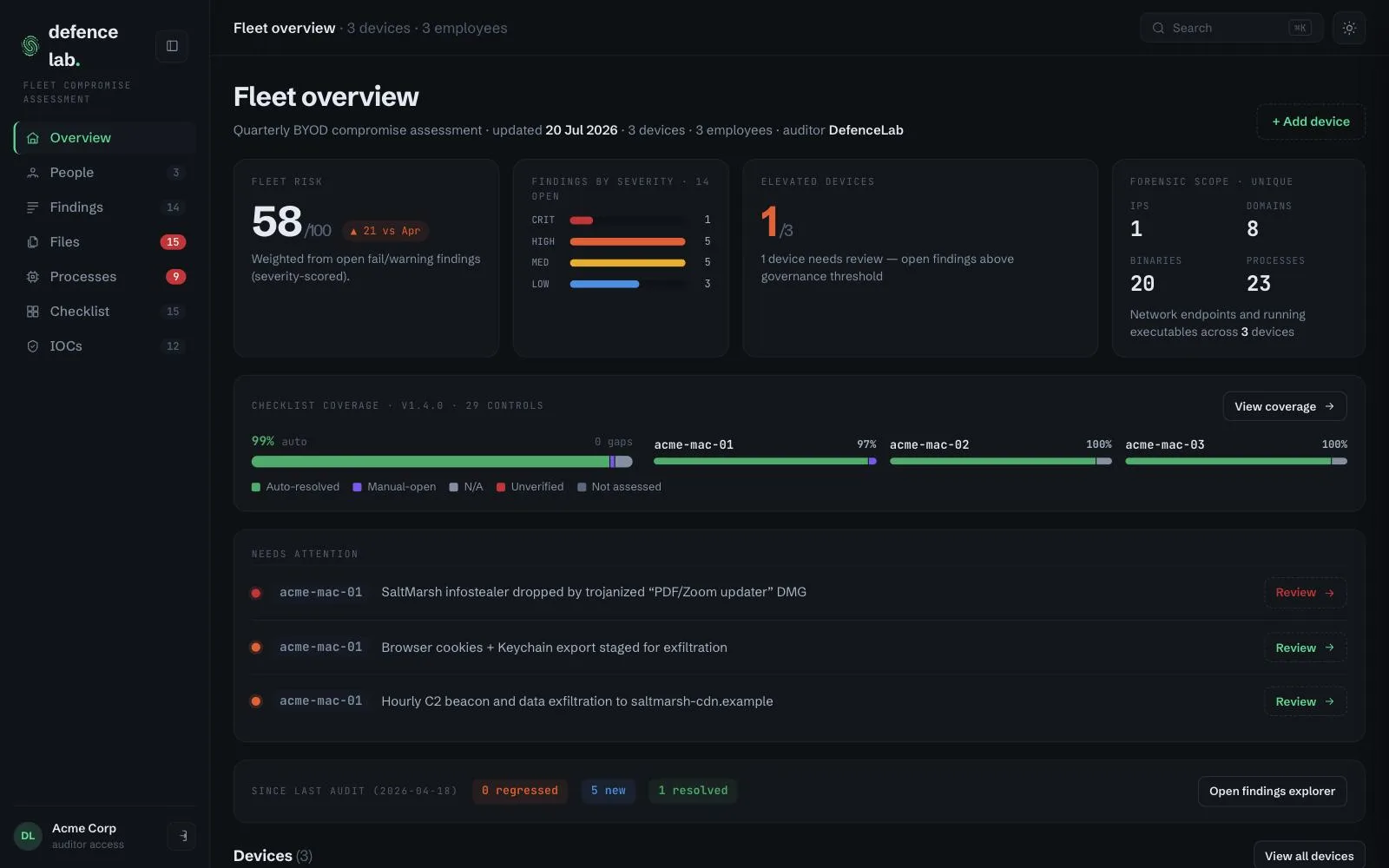
Fleet overview

A compromise assessment — not a hardening checklist, not a cloud scanner

A local-first DFIR platform that audits BYOD Macs against a versioned, forensics-backed checklist, auto-evaluates each check, and seals every artifact with a hash and manifest. It detects active compromise, not just misconfiguration — and nothing ships to a vendor cloud.

Fleet overview
1 / 3

Fleet overview

The biggest blind spot in most security programs

BYOD Macs are invisible to EDR/MDM — they hold company email, source code and admin credentials, but they're personal, so they're unmanaged and un-instrumented.

"Are these laptops compromised?" — when an executive asks, IT usually can't answer with evidence.

No baseline, no chain of custody — a phished admin, a departing employee or an acquisition target leaves no defensible record.

Hardening checklists miss active compromise — passing a config check says nothing about whether a machine is already breached.

Authorization and privacy come first

Authorization is a contractual precondition — the company's signed scope and the device owner's written consent, against an agreed checklist.

Ephemeral per-engagement SSH key, installed for the audit and removed after — no persistent agent left behind.

Offline and data-sovereign — local SQLite plus on-disk evidence store; cloud and AI lookups strictly opt-in and key-gated.

On owner request, a device and all its data are permanently purged. Personal data stays local.

Who it is built for, and who it is not

Built for

  • MSSPs & consultancies delivering fleet compromise assessments / DFIR as a service.
  • End-clients' IT / SecOps teams who work the findings and track remediation.
  • Executives who need a plain-language "are we OK, and what must I decide."

Not the fit

  • Fleets far larger than ~20 personal MacBooks re-audited every few months.
  • Teams wanting a live scanner or an always-on alert dashboard.
  • Anyone needing Windows or mobile coverage — this is macOS.

Evidence you can verify independently

Every artifact is SHA-256 hashed at collection; findings are append-only with a full revision trail; each audit ships a manifest, and one command re-hashes everything and flags MODIFIED/MISSING. Re-audit diffing verifies remediation of previously identified findings against the baseline. Documented collection and integrity checks support independent review by a lawyer, insurer or acquirer.

DimensionMacBook AuditCloud-hosted assessment
Data residencyLocal-first, offline by defaultIngests telemetry into vendor cloud
Evidence integrityHashed, append-only, manifest, tamper-checkIntegrity shown in the vendor's dashboard
AI verdictsHuman-in-the-loop; a "fail" is never auto-acceptedScoring set by the vendor's model
Coverage honestyA skipped probe is a tracked gapGap handling varies by vendor

From collection to a defensible report

  1. Collect over an ephemeral SSH key — SIP & FileVault, firewall, launch daemons/agents, code-signing anomalies, process→endpoint network mapping, browser forensics, anti-forensic timestomping, and insider-threat indicators.

  2. Cross-check offline — match collected network flows and binary hashes against mirrored blocklist IP, known-malware hash, and spyware/stalkerware IOC feeds on a NAS, with zero outbound traffic.

  3. Auto-evaluate each check, with a human accepting or rejecting any proposed "fail".

  4. Diff against the baseline and previous run — "3 came back, 2 fixed, 1 new".

  5. Publish a client-ready report plus an Exec ⇄ Analyst review dashboard.

Three ways to engage, priced per engagement

Per-device, periodic

Best for
Recurring quarterly BYOD assurance
What you get
Predictable assurance across a stable fleet

Final quote scoped per engagement.

Per-client self-hosted instance

Best for
MSSPs standardizing across clients
What you get
Data sovereignty, unlimited internal re-use

Final quote scoped per engagement.

Scope an assessment of your fleet

Book a scoping call for a compromise assessment of your — or your client's — MacBook fleet, and see the evidence sealing, offline threat-intel cross-check and re-audit diffing on the Acme Corp demo data.

Book a scoping call